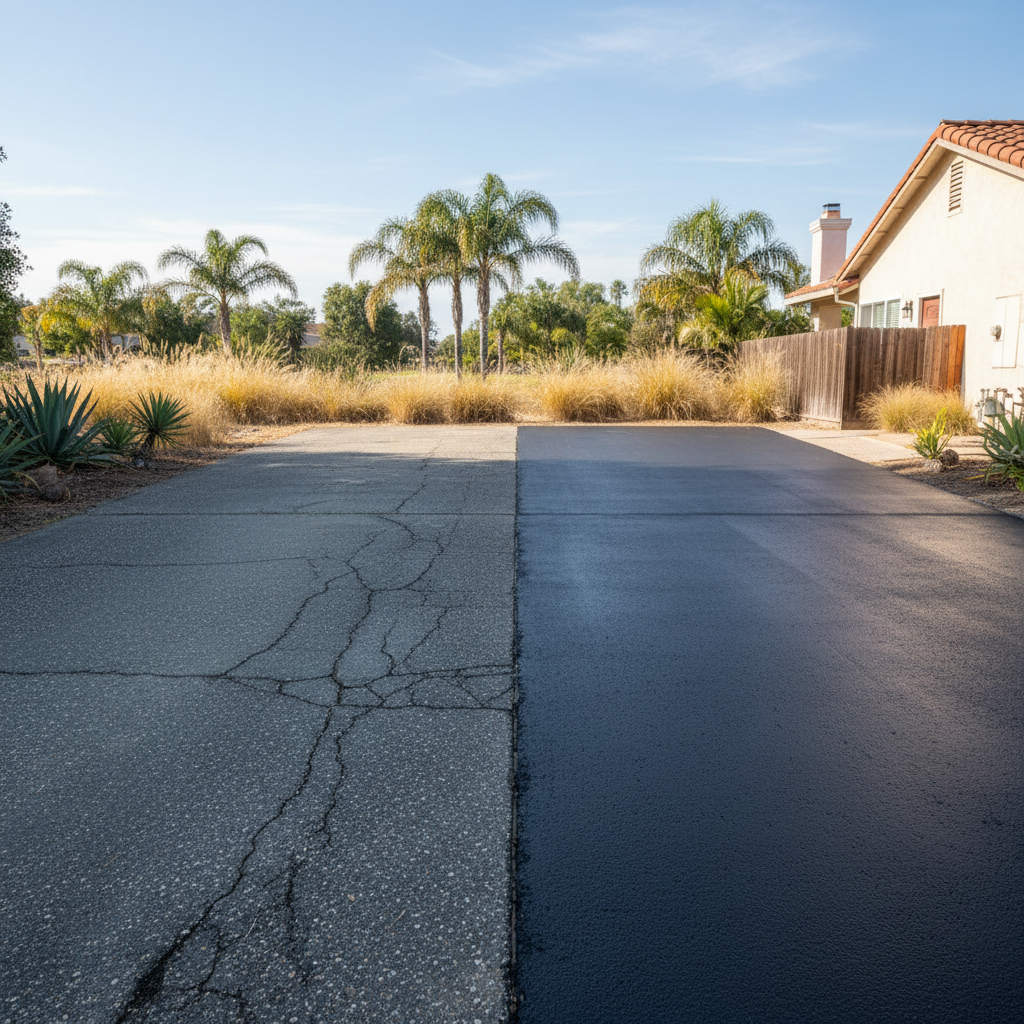
Alright, let's talk sealcoating. You've got a driveway, maybe a parking lot, and you know it needs protection. But when you start looking into it, you'll hear about a couple of main types of sealers: coal tar emulsion and asphalt emulsion. People ask me all the time, "Which one's better, Mike?" It's not always a simple answer, but I can tell you what I've seen work best here in Ventura.
Coal Tar Emulsion: The Old Workhorse
For decades, coal tar was the go-to. It's petroleum-based, and it's known for being tough as nails. When it comes to chemical resistance, it's pretty much unbeatable. Oil spills, gasoline drips, power steering fluid – coal tar shrugs 'em off. That's a big deal, especially if you've got older cars that might leak a bit, or if you're working on projects in your driveway.
It also gives you that really deep, rich black color that a lot of folks like. It looks sharp, especially right after it's applied. And typically, it's been a little cheaper per gallon than asphalt emulsion, which is always a factor for homeowners, right?
Now, the downside. Coal tar has a pretty strong smell when it's applied, and it can linger for a few days. It's also not as flexible as asphalt emulsion. What does that mean for us in Ventura? We get some pretty significant temperature swings, especially inland. When the ground moves or cracks develop, coal tar is more likely to crack right along with it. It's also been under some environmental scrutiny, and while it's still available, some areas have restricted its use. We always follow local regulations, of course.
Asphalt Emulsion: The Modern Contender
Then you've got asphalt emulsion. This stuff is, well, asphalt-based. Makes sense, right? It's essentially liquid asphalt mixed with water and other additives. The biggest advantage here is flexibility. It's much more elastic than coal tar. That's a huge plus for driveways here in Ventura, especially with our clay soils that can shift a bit and cause stress on your pavement. It moves better with the pavement, so you'll often see fewer hairline cracks developing in the sealcoat itself.
Asphalt emulsion also has a much milder smell. It's not nearly as pungent as coal tar, which your neighbors (and your nose) will appreciate. Environmentally, it's generally considered a greener option, something more and more people care about.
So, what's the catch? It's usually a bit more expensive upfront than coal tar. And while it's good at protecting against UV rays and water, it's not quite as bulletproof against petroleum spills. A big oil leak might stain it more than it would a coal tar surface. The color, while still black, can sometimes be a slightly lighter shade or fade a little faster than coal tar's deep black.
Durability, Appearance, and Maintenance
- Durability: Both are designed to protect your asphalt, but they do it differently. Coal tar is tough against chemicals; asphalt emulsion is tougher against cracking from movement and temperature changes. For a typical Ventura residential driveway, where cracking is a bigger concern than constant chemical spills, asphalt emulsion often wins out on overall longevity of the sealcoat itself.
- Appearance: Coal tar gives you that super deep, almost wet-look black. Asphalt emulsion is a rich black too, but sometimes a hair less intense. Both look great when fresh.
- Maintenance: No matter which you choose, you'll still want to keep your driveway clean. Sweep off debris, wash away dirt. If you get a big oil spill on asphalt emulsion, try to clean it up quickly.
- Cost: Coal tar usually has a lower material cost. Asphalt emulsion is typically a bit higher. But remember, the cheapest option upfront isn't always the cheapest in the long run if it doesn't hold up as well to our local conditions.
My Recommendation for Ventura Homeowners
Look, I've been doing this for a long time with Omega Asphalt Inc. and I've seen what holds up best around here. For most homeowners in Ventura, especially those living closer to the hills where you get more expansion and contraction, or on properties with older, more settled ground, I lean towards asphalt emulsion.
Why? Our climate. We get hot sun, cool nights, and sometimes those Santa Ana winds dry everything out. That constant heating and cooling, coupled with any ground movement, puts a lot of stress on pavement. The flexibility of asphalt emulsion means it handles those stresses better, leading to fewer premature cracks in the sealcoat. You're getting better protection against the elements that actually cause your driveway to degrade here.
While coal tar is a beast against chemicals, most residential driveways aren't seeing daily chemical warfare. They're seeing sun, rain, and temperature changes. For that, asphalt emulsion is just a better fit. It might cost you a few bucks more upfront, but you'll likely get a longer-lasting, more aesthetically pleasing result that stands up to Ventura's conditions.
Ultimately, the goal is to protect your investment. A good sealcoat, properly applied, will extend the life of your asphalt by years, no matter which type you choose. Just make sure you're getting a quality product and a professional application.